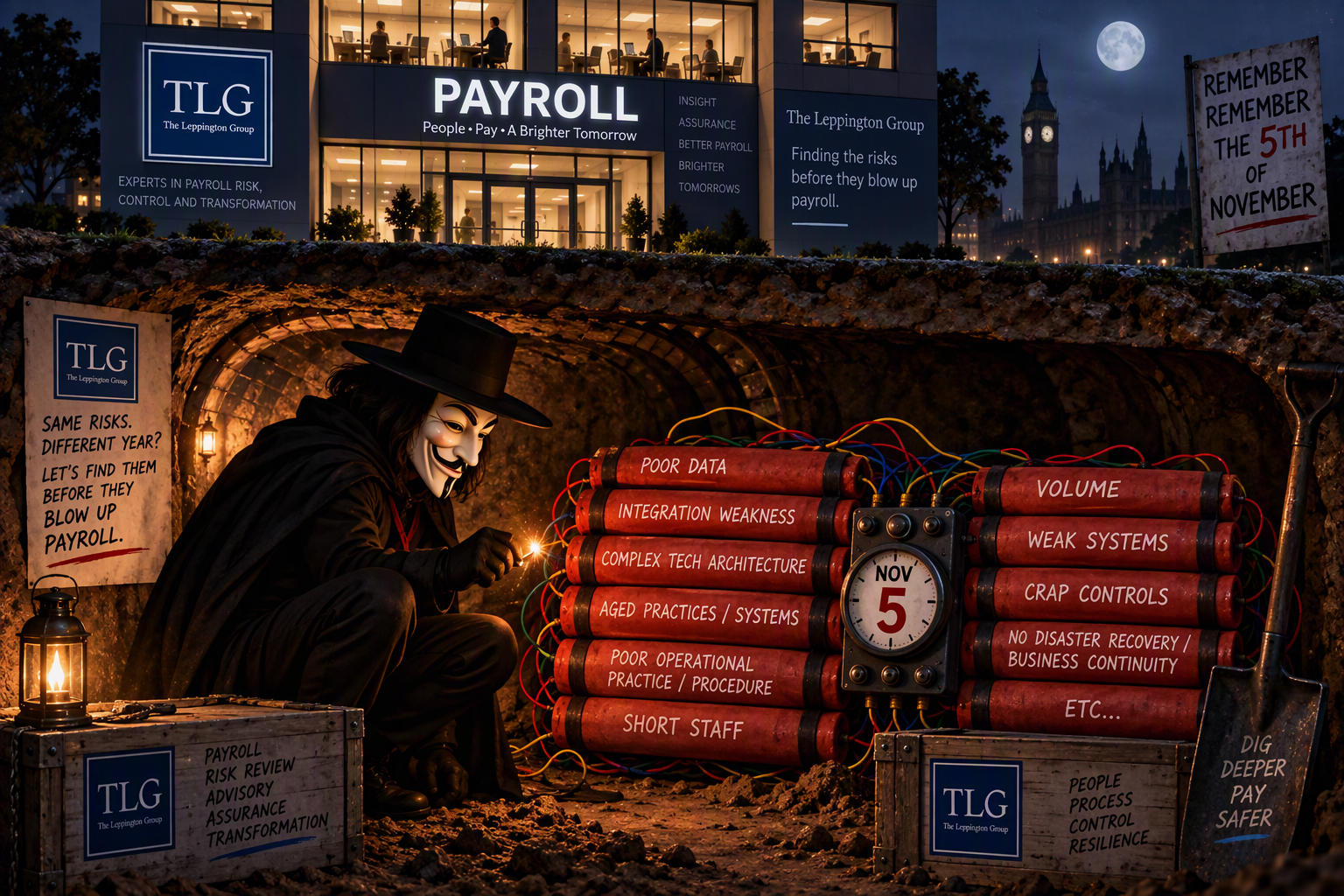
There’s a lot of things that can go wrong in payroll. But rarely does a catastrophe happen out of nowhere. More often than not, there is a lengthy, quiet build-up before an issue finally explodes.
Like the slow-burning fuse of a gunpowder plot, the signs are often there from the start. A missed checklist item. An ignored warning. A quick fix that becomes a permanent patch. These small oversights might seem harmless in the moment, but they accumulate, hidden beneath the surface, waiting for the right moment to detonate.
Spotting these signs is crucial to a compliant payroll. It’s the difference between a smooth go-live and a system meltdown. It’s the difference between a routine month and a nightmare scenario.
Let’s look at a perfectly on-theme example!
Act I: The Conspiracy Begins
March: The Spark
In March, the decision was made: the old payroll system was no longer fit for purpose. It had become a liability, prone to errors, resistant to updates, and incapable of meeting the demands of a growing organisation. A new system was confirmed, one that promised efficiency, accuracy, and compliance.
Over the next several months, the payroll team worked vigorously to transfer all the data over in time for the go-live, which was scheduled for June. Every task, every deadline, every sleepless night was dedicated to making this transition a success.
To ensure the second system was set up properly, there was a comprehensive checklist, a meticulous guide to avoid disaster. It was their shield against chaos. But like the forgotten guards of the House of Lords, the checklists were ignored. Sign-offs were rushed. Fields were left blank. And no one asked why.
The team moved forward, convinced that the system would hold. But the cracks were already forming.
June: The First Crack
June arrived, and the go-live was postponed. There were missing bank details. The news spread quickly, met with groans and muttered complaints. Missing bank details weren’t uncommon, but this time, it felt different. It wasn’t just one or two employees; it was dozens. Entire departments were missing critical payment information.
You guessed it, it turned out the checklists hadn’t been updated properly. The team had assumed the data migration would be seamless, that the old system’s records would transfer over without issue. But no one had double-checked.
The delay was brushed off as a minor inconvenience. “We’ll catch it next time,” someone said. “It’s just one delay,” another added. A minor delay. A small setback. Nothing to worry about. Just a hiccup in an otherwise smooth process.
But in reality, it was the first crack in the dam. A sign that the foundation beneath them wasn’t as solid as they believed. The team carried on, reassuring themselves that they had time to fix it. They didn’t.
Act II: The Slow Burn
July to September: The Fuse Burns
The year continued, and the initial optimism of the transition began to wane. Progress was made, data was migrated, systems were configured, and the team worked tirelessly to meet each new deadline. But it wasn’t going as smoothly as they had hoped.
There was an incorrect pension calculation here, an incorrect National Insurance contribution there. Each mistake was caught and corrected, but the fixes felt more like damage control than progress. The team treated them as isolated incidents, anomalies that could be resolved without deeper investigation.
The urgency of the go-live deadline created a sense of tunnel vision, where only the most immediate tasks mattered. In-depth changes, those that required time, scrutiny, and a willingness to confront the flaws in the system, were deferred in favour of Band-Aid solutions. The foundation was cracking, but the team kept adding more bricks, hoping the structure would hold.
October: The Warning Whispered
Then it was October. A payroll team member, someone who had been quietly observing the mounting issues, finally spoke up. They raised concerns about the lack of parallel runs, those critical side-by-side comparisons of the old and new systems that could reveal discrepancies before they became disasters.
They suggested that some thorough data reconciliation would be invaluable before the go-live, a final safeguard against the errors that had plagued the transition. Their voice was measured, their concerns valid, but the response from the team manager was dismissive.
The concerns were shared with the payroll team manager, who listened but ultimately decided to let the team continue as they were. The plan remained unchanged: they would make adjustments at the last minute, trusting in their ability to troubleshoot under pressure. It was a gamble. A dangerous one.
The rest of the team found out about the raised concerns and their manager’s response. Some hesitated, weighing the risks, but after a flurry of activity to double-check employee data ensuring, or so they thought, that everything was correct, they decided to go along with the decision.
The go-live couldn’t be pushed back again. The pressure was too great. The momentum was too strong. The team had invested too much to turn back now.
The plot was set. The fuse was lit.
Act III: The Night of the Go-Live
The Day Before: A Superficial Fix
The day before the go-live arrived, and with it came a false sense of security. The team was exhausted, running on caffeine and sheer determination, but there was also a palpable relief that the finish line was finally in sight. Final checks were performed, though not with the meticulous attention they deserved.
The urgency of the deadline had eroded the patience for thoroughness, and the mindset had shifted from “getting it right” to “getting it done.”
Amid the flurry of last-minute tasks, an incorrect tax calculation was spotted. It was a small error, easy enough to correct in the moment. A few keystrokes, a quick save, and the issue was resolved. The team moved on, satisfied that another potential disaster had been averted.
But this was no more than a superficial fix, a bandage slapped onto a bullet wound. They had patched the hole, yes, but they hadn’t fixed the leak.
The underlying issue remained, lurking beneath the surface, waiting for the right moment to resurface. And no one stopped to ask whether this was truly the last of the problems or merely the quiet before the storm.
Hours Before Midnight: The Final Discovery
Just hours before the go-live, as the final countdown ticked away, someone, perhaps sensing the weight of everything that had gone wrong up to that point, demanded a last, truly thorough check. No half-measures. No rushed glances. This time, every calculation, every field, every line of code would be scrutinised with absolute precision.
And then it was found. Another incorrect tax value. Not just a minor discrepancy this time, but something deeper, more insidious. A payroll team member, wide-eyed with realisation, didn’t just correct the number. They pushed on. They dug into the system’s logic, tracing the calculations back to their source.
They figured out how the system was calculating pay elements and realised that simply overwriting the incorrect value wasn’t going to work. The tax calculations weren’t just wrong; they were fundamentally broken, constructed on a foundation of shortcuts and assumptions that had never been properly tested.
But this time, there was no panic. No frantic attempts to force a patch that wouldn’t hold. Instead, the team rallied and they dissected the problem, untangled the logic, and began the painstaking work of rebuilding what had been broken. They didn’t just patch the hole; they rebuilt the floor.
Every incorrect assumption was corrected. Every flawed calculation was recalibrated. The system wasn’t just fixed; it was reinvented in those final hours, transformed from a liability into something that might actually work.
It was a miracle. A last-second rescue. But it also served as a brutal reminder: had they only looked deeper, sooner, this disaster might never have happened.
Epilogue: The Aftermath
No one went missing, no employees were left unpaid, no direct deposits failed, no compliance filings were missed. No one was fired, at least, not immediately. The team’s jobs were safe, their reputations intact, their collective sigh of relief palpable. But the scare was real. It clung to them like the acrid tang of smoke after an explosion, a reminder of how close they had come to catastrophe.
For weeks afterward, the team would catch themselves holding their breath whenever a new payslip batch was processed, half-expecting another error to surface. The trauma lingered in the way they double- and triple-checked every figure, in the hushed conversations in the break room, in the unspoken understanding that they had been lucky this time.
The Plot of 2026 was averted, but only by the skin of its teeth.
The story of this payroll go-live is a modern-day Gunpowder Plot. It wasn’t a single explosion that nearly destroyed the team, but a series of small, ignored warnings that nearly led to one. Just like Guy Fawkes and his conspirators, the initial errors seemed insignificant, a missing bank detail here, an incorrect pension calculation there, a checklist checkbox ticked without verification.
But left unchecked, these seemingly minor oversights accumulated, layer upon layer, until they formed a dangerous powder keg of non-compliance, data chaos, and systemic fragility. The pressure mounted unseen, until the entire operation was balanced on the edge of collapse.
The team was saved only because one person refused to ignore the signs. They looked beneath the surface. They questioned the quick fixes. And in the final hours, they dismantled the plot before it could detonate.
But let’s be clear: luck is not a strategy.
Relying on a last-minute hero to save the day is not a sustainable payroll process. It’s a recipe for stress, burnout, and potential compliance failures that could have been avoided with proper planning.
The lesson is this: payroll is not the place for gambles. The stakes are too high, the consequences too severe. Because when it comes to payroll, the only explosion that should ever happen is the one that happens on bonfire night, not in your systems, not in your deadlines, and certainly not in the trust your employees place in you.
Why You Should Contact Us
The Leppington Group Limited (TLG) is a UK headquartered company specialising in payroll advisory, audit, and consulting services.
Originally founded in 2011, TLG has established itself as a reputable, independent, and trusted partner for organisations seeking expert guidance for any aspect of payroll requirements.
TLG's core services include payroll audit & health checks, issue navigation, procurement, vendor selection, implementation guidance, project mediation, payroll administration, and cyber & privacy services.
TLG's commitment to excellence, and a customer-centric approach, has elevated the organisation as a valuable resource for businesses seeking to optimise their payroll processes without the ‘Big Four’ price tag.
TLG exists to make payroll simpler, businesses better and results clearer.